Epitalon in gingival stem-cell cultures
The surprising starting material is gum tissue; the measured destination is a set of nerve-related markers.
The gingival-cell experiment
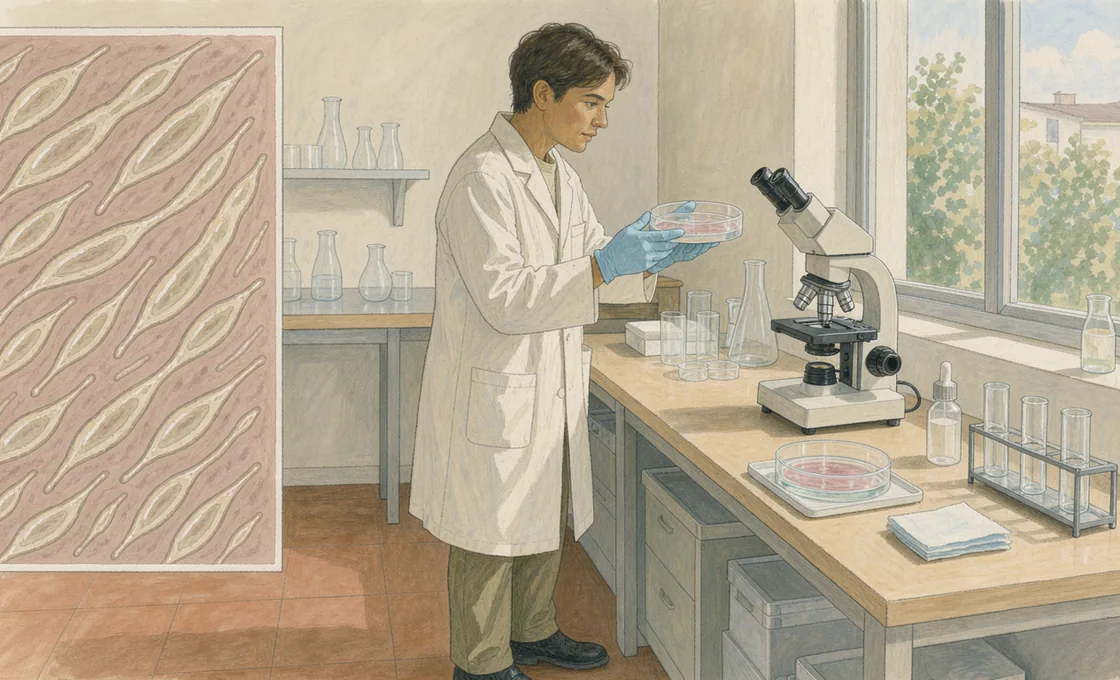
The AEDG study in human gingival mesenchymal stem cells reported increased neurogenic differentiation markers in vitro, meaning in laboratory culture. The markers included Nestin, GAP43, beta-tubulin III and doublecortin. The reported increase in their mRNA was approximately 1.6–1.8 times. mRNA carries the cell's gene messages.
I enjoy the specificity of the starting point. “Stem cells” alone could suggest almost anything; gingival mesenchymal stem cells tell this experiment's more unusual story. The nerve-related markers supply the proposed direction of travel.
The paper gives a measurable change in a cultured cell population. A complete change of cellular profession would need to answer something the marker response leaves open: what could the resulting cells actually do?
The proposed histone connection
The same study proposed preferential AEDG binding to histones H1/6 and H1/3, supported by molecular modelling. Histones are proteins around which DNA is organised. Here the binding idea is a proposed explanation for regulation of the nerve-related markers.
That gives the experiment a second object of interest: a possible interaction with the cell's gene-regulating apparatus. I would display the model beside the marker measurements, with a little space between them. Modelling a preferred interaction and measuring a change in mRNA answer different questions.
I would trust this explanation more after a direct test of the proposed interaction. Until then, “possible epigenetic mechanism,” the caution in the paper's title, seems a well-chosen description.
From marker expression to function
The reported outcomes are differentiation-marker changes in human gingival stem-cell cultures. The source does not report a neurological treatment or a clinical outcome. My curiosity now turns to a functional experiment: could cells with these altered markers perform the relevant nerve-cell tasks?
That question gives the result a direction without announcing an arrival. A marker can be informative while the destination remains open.
A different version of cellular renewal appears in Epitalon and telomeres, where the measured change concerns chromosome ends. In collagen research, the subject becomes material made around cells.