GHK-Cu and collagen production
What cells make around themselves gives renewal a material form.
Collagen synthesis with cell number unchanged
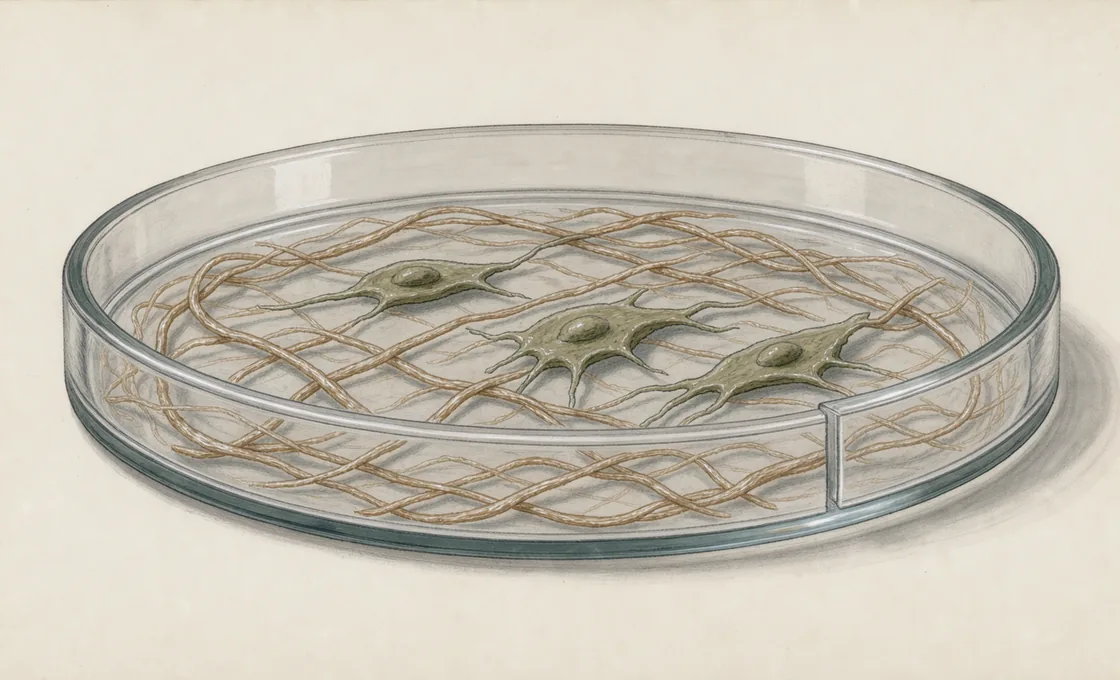
The human fibroblast-culture experiment with GHK-Cu reported increased collagen synthesis while cell number stayed unchanged. I appreciate that qualification. The finding concerns what the cultured cells made, without an increase in the cell population doing the explanatory work.
My first assumption was that the striking part would be the increase in collagen alone. The unchanged cell number makes it more specific: the measured response concerned synthesis in the cells already there. That is a small experimental distinction with a large effect on the story.
This result has a different character from the gingival stem-cell markers. One concerns material production; the other concerns messages associated with a possible change of cell identity. “Renewal” covers both rather too easily.
The proportions reported in women
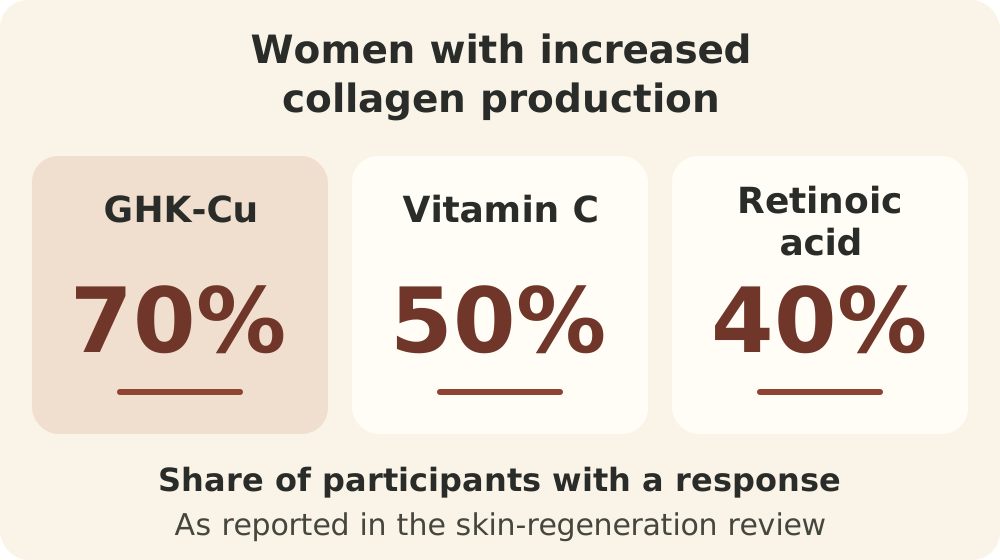
A skin-regeneration review reports increased collagen production in 70% of GHK-Cu-treated women, compared with 50% for vitamin C and 40% for retinoic acid. These are shares of participants with increased production. They are not measurements of how much extra collagen each person made.
For me, that distinction changes the picture immediately. “70%” can look like a quantity of collagen when it is actually describing the women in whom an increase was reported. The review supplies the comparison; it does not license a claim of 70% more collagen.
I treat these figures as a reason to examine the underlying clinical work, including the preparation and the outcome assessment, before turning them into a general comparison of skincare approaches.
The wider tissue matrix
The skin-regeneration review also describes synthesis of dermatan sulfate, chondroitin sulfate and decorin. A broader tissue-remodelling review discusses collagen, elastin, metalloproteinases and anti-proteases across human and animal studies. Together they give collagen some company: matrix research concerns the material around cells and the machinery that handles it.
I prefer that fuller material picture to a single heroic fibre. Collagen can remain the main attraction while the other components help explain why remodelling is a more complicated ambition than accumulation.
There is a practical obstacle before a topical preparation reaches its intended setting. The skin-barrier page gives penetration and retention their own room.